Exploring the Procreate Tie-dye Brush Set for Digital Textile Design
Digital illustration has evolved far beyond simple line art and flat color fills. Today, creators are increasingly seeking tools that replicate the organic unpredictability of traditional media, particularly when designing for print-on-demand products or textile patterns. The Procreate Tie-dye Brush Set emerges as a specialized resource aimed at bridging this gap. Designed specifically for the Procreate app on iPad, this collection offers a streamlined approach to creating freestyle tie-dye effects, complete with textured canvases that simulate real-world fabrics. For digital artists, graphic designers, and small business owners looking to expand their product lines, understanding the utility and limitations of such niche brush sets is essential for efficient workflow management.
Core Components and Technical Specifications
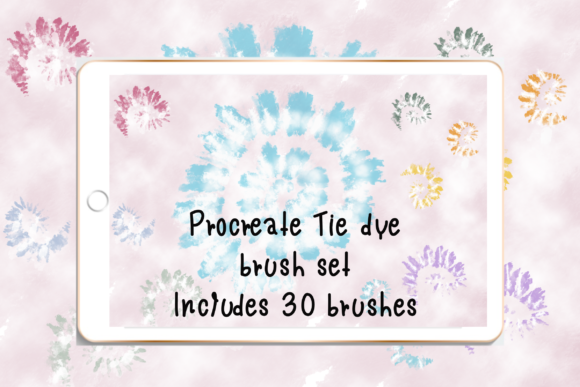
The primary value proposition of this asset lies in its specificity. Unlike general-purpose watercolor or ink brushes, the Procreate Tie-dye Brush Set is engineered to mimic the fluid dynamics and bleeding patterns characteristic of dyed fabrics. The package includes a single ZIP file containing 30 distinct brushes. This volume provides a reasonable variety without overwhelming the user interface, allowing for quick selection during the creative process.
Beyond the brushes themselves, the set includes texture overlays for fabric, paper, t-shirts, and face masks. These additions are critical for realism. A tie-dye pattern looks significantly different on smooth digital paper than it does on the woven texture of a cotton t-shirt. By providing these specific canvas textures, the creator acknowledges that context matters in digital design. The inclusion of face mask textures is particularly relevant, reflecting recent market trends where custom protective wear became a popular canvas for artistic expression.
Usability and Installation Process
For users familiar with the Procreate ecosystem, the installation process is straightforward, though it requires attention to detail. Upon purchase and payment confirmation, users receive an email with a download link. The file must be downloaded to the iPad or a connected device and then imported into the Procreate app. The standard procedure involves tapping the brush library, selecting "Import," and choosing the .brushset file.
While the technical barrier to entry is low, the learning curve involves mastering how these stamps interact with layers. The brushes function as stamps, meaning they apply pre-designed shapes or patterns with a single tap or stroke. This differs from painting each dye fold manually. For professionals, this distinction is vital. Stamp-based brushes offer speed and consistency, which is advantageous for commercial projects with tight deadlines. However, they may require additional manipulation—such as warping, opacity adjustments, or layer blending modes—to avoid a repetitive or "stamped" look.
Practical Applications for Creators and Businesses
The Procreate Brush stamps are versatile enough to serve various professional needs. Their primary application is in the creation of apparel designs. T-shirt designers, in particular, benefit from the ability to rapidly prototype tie-dye backgrounds. Instead of spending hours simulating liquid dispersion manually, an artist can lay down a base using the tie-dye stamps, adjust the colors to match brand guidelines, and overlay graphics or typography. This efficiency translates directly into higher productivity for freelancers and agency designers.
Furthermore, the set supports commercial use, a crucial factor for entrepreneurs. Small business owners who sell digital assets, print-on-demand merchandise, or custom stationery can integrate these brushes into their product offerings. The included paper textures also extend the utility beyond textiles, allowing for the creation of digital scrapbooking elements, greeting cards, and poster art. The flexibility to use the assets for both personal and commercial projects enhances the long-term value of the purchase, making it a viable investment for serious hobbyists transitioning into professional markets.
Evaluating Quality and Realism
When assessing digital brushes, the key metric is often how well they deceive the eye. Do they look like a digital approximation, or do they capture the essence of the physical medium? The Procreate Tie-dye Brush Set leans towards stylized realism. The freestyle nature of the inspiration means the patterns are not rigidly geometric, offering a natural, organic feel. However, users should note that "freestyle" implies variability. Some stamps may require rotation or scaling to fit specific design compositions seamlessly.
The texture canvases play a significant role in enhancing perceived quality. A flat tie-dye pattern can appear artificial, but when applied over a fabric texture with appropriate blending modes (such as Multiply or Overlay), the result gains depth and tactile appeal. This layered approach is standard practice in high-end digital textile design. The set provides the necessary components to achieve this look, but the final outcome depends heavily on the user’s understanding of layer properties and color theory. It is not a one-click solution for photorealism, but rather a robust toolkit for achieving a convincing aesthetic with moderate effort.
Target Audience and Workflow Integration
Who benefits most from this tool? The ideal user is likely an intermediate to advanced Procreate user who already understands layer management and blending modes. Beginners might find the stamp-based approach limiting if they expect the brush to automatically handle all aspects of lighting and fabric folds. Conversely, experienced illustrators will appreciate the time saved on repetitive pattern generation.
- Print-on-Demand Sellers: Can rapidly generate unique designs for t-shirts, tote bags, and masks.
- Graphic Designers: Useful for creating trendy, bohemian-style backgrounds for branding materials or social media content.
- Educators and Students: Provides a practical example of how digital tools can simulate traditional textile arts.
- Hobbyists: Allows for experimentation with complex patterns without the mess and cost of physical dyes.
Integrating these brushes into an existing workflow requires a shift in mindset. Rather than viewing them as painting tools, users should treat them as asset libraries. Combining multiple stamps, varying their opacity, and using clipping masks can prevent designs from looking generic. The reliability of the brushes is generally high, as they are static assets that do not depend on complex algorithms or pressure sensitivity variations to function correctly. This consistency ensures that what you see on the screen is largely what you get in the final export, provided the resolution settings are appropriate for the intended print size.
Limitations and Considerations
Despite its strengths, the Procreate Tie-dye Brush Set has limitations. As a stamp-based system, it may lack the granular control of hand-painted techniques. Artists seeking highly specific, custom dye folds may find the predefined shapes restrictive. Additionally, while the included textures are helpful, they are fixed resolutions. Users planning to print on very large formats, such as banners or full-size tapestries, should verify that the texture files have sufficient DPI (dots per inch) to avoid pixelation.
Another consideration is the saturation of the market. Tie-dye aesthetics have fluctuated in popularity. While currently relevant, relying solely on trend-driven assets can be risky for long-term business strategies. However, the fundamental utility of texture and pattern brushes remains constant. Even if the tie-dye trend wanes, the techniques learned in manipulating these layers and textures are transferable to other styles of digital painting and design.
Final Verdict on Value and Utility
The Procreate Tie-dye Brush Set represents a practical, focused tool for digital creators. It does not attempt to be an all-encompassing solution but instead excels in its niche. For professionals and entrepreneurs who need to produce textile-inspired designs efficiently, the time saved justifies the cost. The inclusion of commercial usage rights further enhances its appeal for business-oriented users.
Success with this tool depends on the user’s willingness to engage with the material creatively. It is not a magic button but a sophisticated set of stamps that, when combined with skillful layering and texturing, can produce high-quality, market-ready artwork. For those looking to expand their digital toolkit with specialized, texture-rich assets, this set offers a balanced combination of convenience and creative potential. It serves as a reminder that in digital art, the right resources can significantly accelerate the journey from concept to final product, provided they are used with intention and technical understanding.